Two versions. One child. Both are real.
A practical online masterclass for parents and professionals that will help you understand why the SAME child can look completely different at school and at home, how to recognise what may be happening underneath, connect the two pictures and consider what needs to change.
📅 Monday 26th October
🕢 7:30pm
💻 Online
💷 £19
Everyone who registers receives one month’s access to the recording.

“BUT WE DON’T SEE THAT AT SCHOOL…”
At school:
“They’re settled.”
“They join in.”
“They’re doing their work.”
“They seem happy.”
“We don’t see any of this.”
At home:
“They’re exhausted.”
“They explode over the smallest thing.”
“They can’t tolerate being asked a question.”
“They shut down.”
“They can’t cope with things they’d normally manage.”
And somewhere in the middle is a child whose nervous system is telling us something.
What if nobody is wrong but nobody is seeing the whole picture?

At school, they might be:
-
Quiet.
-
Helpful.
-
Compliant.
-
Joining in.
-
Following instructions.
-
Talking to friends.
-
Completing their work.
-
Maybe even laughing and appearing genuinely happy.
-
Then they get home.
-
They cry.
-
Shout.
-
Withdraw.
-
Hide.
-
Need control.
-
Can’t tolerate demands.
Or collapse on the sofa with absolutely nothing left.
It can feel like two completely different children.
And that difference can create a huge disconnect between home and school.
Parents can feel like they're not being believed.
Professionals can genuinely struggle to understand because the child they see in front of them appears to be coping.
But both presentations can be real.
The question isn't:
“Which version is the real child?”
The more useful question is:
“Why is this child’s nervous system responding so differently in each environment?”
THE SAME CHILD CAN LOOK COMPLETELY DIFFERENT IN TWO DIFFERENT ENVIRONMENTS.
BEHAVIOUR ONLY SHOWS US PART OF THE PICTURE.
A child can participate…Communicate….Complete their work….Follow instructions….Smile….Laugh.
And still have a nervous system that is working incredibly hard underneath.
Throughout a school day, their brain and body may be managing:
-
Noise.
-
Movement.
-
People.
-
Learning.
-
Sensory information.
-
Transitions.
-
Communication.
-
Social expectations.
-
Uncertainty.
-
Instructions.
-
Rules.
-
Body signals.
-
And the constant work involved in figuring out what happens next and what is expected of me?
Sometimes they manage all of that.
But “they managed it” doesn’t automatically tell us what it cost.
And sometimes we don't see that cost...
until later.

THAT’S WHERE THE SNOWBALL EFFECT COMES IN.
The Snowball Effect is an online masterclass exploring the nervous-system science behind why a child can appear to cope in one environment and respond completely differently in another.
But I don't want to simply teach you some interesting neuroscience.
I want to give you a different way of looking at the child.
Because when we put together:
what school sees
what home sees
what happens afterwards
we begin to build a much richer picture of what that child's nervous system may actually be managing.
And that can change the questions we ask and the support we put around them.

IN THE MASTERCLASS, I’LL SHOW YOU HOW TO:
SEE
Look beyond whether the child simply “managed”.
We'll explore why looking settled, compliant or engaged doesn't always tell us how much effort something is taking.
You'll start thinking about:
✓ what the child looks like in different environments
✓ the subtle changes that may be easier to miss
✓ what their behaviour might look like when they are working hard to cope
✓ why capacity can change throughout the day
✓ why a child can genuinely appear happy AND still be using significant nervous-system resources
The aim isn't to start looking for problems where there aren't any.
It's to become more curious about what behaviour alone may not be showing us.
CONNECT
Put the pieces together across environments.
Instead of treating school behaviour, home behaviour and the aftermath as completely separate things, we'll start looking at how they may connect.
We'll explore:
✓ why a response can happen hours after the experience that contributed to it
✓ why the journey home or walking through the front door can sometimes trigger a huge shift
✓ why seemingly simple demands can suddenly become impossible after school
✓ what shutdown, exhaustion, increased sensitivity or emotional responses afterwards might tell us
✓ why “they were fine here” and “they fell apart at home” don't necessarily contradict each other
And importantly:
What does the difference between those two environments tell us about the child?
CHANGE
Use that understanding to consider what might need to be different.
Understanding the nervous system is useful.
But understanding should change what we do.
We'll start thinking about:
What might be adding unnecessary load?
What could be adapted?
Where might expectations need to change?
What could be made more predictable?
Where might the child need more support?
When does recovery need actively protecting?
And one of the biggest questions:
Are we measuring success by whether the child participated or considering the cost of that participation too?
YOU’LL LEAVE WITH A DIFFERENT WAY OF LOOKING AT THE CHILD.
By the end of The Snowball Effect, you'll have a simple framework for bringing together:
What school sees + what home sees + what happens afterwards.
You'll be able to use those three pieces of information to start identifying:
✓ where the child's nervous system may be working harder than it appears
✓ less obvious signs that their capacity may be changing
✓ what the after-effects could be telling you about the cost of coping
✓ what might be contributing to that load
✓ where demands, environment or expectations could be adapted
✓ where recovery may need to be actively protected
So you're not just left understanding why the child can look different.
You leave knowing what to start looking for and what to consider changing.

IF YOU’RE A PARENT…
This is for you if you've ever tried to explain what happens at home and felt like you're describing a child nobody else recognises.
Maybe you've heard:
“They’re absolutely fine once you leave.”
“They’re happy here.”
“We don’t see any of that behaviour.”
Or you've found yourself questioning what you're seeing because the child described at school sounds so different to the one who comes through your front door.
I want to help you understand why that difference can happen.
And give you clearer language to communicate what you're seeing without having to prove that one version of your child is more “real” than another.
IF YOU’RE A PROFESSIONAL…
This is for you if you've ever supported a child who genuinely appears settled, engaged or happy in your environment...
while their family is describing significant distress, exhaustion, shutdown or dysregulation elsewhere.
That can be incredibly difficult to make sense of.
The answer isn't to assume that what you're seeing isn't real.
It is.
But it might not be the whole picture.
I'll help you understand how a child's nervous system can respond differently across environments and why information about what happens before and after school can help us understand what we're seeing during the school day.
THIS IS NOT ABOUT BLAMING SCHOOL.
And it isn't about blaming home.
It's not about proving that parents were right.
Or telling professionals they've missed something.
It's about recognising that:
Context matters.
The demands are different.
The sensory environment is different.
Relationships are different.
Expectations are different.
Opportunities for recovery are different.
And a child's nervous system can respond differently too.
Rather than home and school defending the version of the child they see...
What happens if we put both pictures together?
✔️appears to cope at school but falls apart afterwards
✔️has very different presentations at home and school
✔️seems settled or compliant in education but needs significant recovery afterwards
✔️experiences after-school meltdowns, shutdown or exhaustion
✔️appears able to meet expectations in one environment but not another
✔️becomes increasingly depleted as the school day or week progresses
✔️struggles to explain what feels difficult
✔️appears to hold things together until they reach a familiar environment
✔️has inconsistent capacity that can be difficult for adults to understand
✔️is beginning to struggle with accessing or consistently attending school
✔️leaves parents and professionals with two very different pictures of the same child
No diagnosis is required.
And you don't need previous knowledge of neuroscience, sensory processing or nervous-system theory.
I'll make the science simple, relatable and practical.

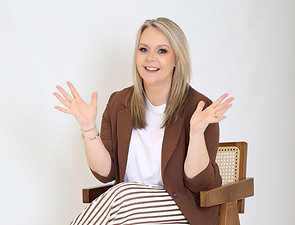
I’m a Sensory & Behavioural Specialist with almost 20 years’ experience supporting children, families and professionals.
Through The InnerMe Project, I help adults understand what’s happening underneath behaviour by looking at the child's brain, body, nervous system and environment.
One of the biggest barriers I see is when the adults around a child are seeing very different things.
Not necessarily because somebody is wrong.
But because we're seeing that child:
in different environments,
under different demands,
with different expectations,
and at different points in their capacity.
My work helps bring those pieces together.
And in The Snowball Effect, I'll make the neuroscience behind those differences understandable enough that you can actually use it.